Web Design Trends in 2026 - Future-Ready Design Insights
Explore the top web design trends for 2026—AI-driven UX, hyper-responsive layouts, accessibility, speed, and modern UI styles. Expert insights from Vistas AD Media.

Explore the top web design trends for 2026—AI-driven UX, hyper-responsive layouts, accessibility, speed, and modern UI styles. Expert insights from Vistas AD Media.
In 2026, web design continues to evolve faster than ever, driven by AI, personalization, accessibility, and new interaction technologies. Businesses that update their websites early gain clear advantages—higher engagement, better conversions, and improved SEO visibility.
At Vistas AD Media Communications, we design future-ready websites for brands across the globe. Based on our experience and active work with leading enterprises, SMEs, and startups, here is a comprehensive look at the biggest web design trends that will define 2026.
TABLE OF CONTENT

AI now plays a central role in how users experience websites. In 2026, sites will adapt in real time to:
Personalisation boosts:
At Vistas, we already integrate AI-driven design systems for ecommerce, SaaS, and enterprise websites.
With foldable phones, dual-screen monitors, 4K–8K desktops, and wearables, 2026 websites must adapt beyond the old “mobile-first” approach.
In 2026, web responsiveness isn’t just screen-size adaptation—it’s context adaptation.
More than 50% of users now interact with digital products through voice. This gives rise to voice-first websites.
Web development that embraces voice search sees better usability and improved SEO, especially for long-tail queries.
Users expect websites to load in under 1.5 seconds.
This pushes designers toward:
In 2026, minimalism is not just a style—it is an SEO and performance necessity.
Websites now prioritise simplicity. Users don’t want to “search” for what they need—they want instant clarity.
These micro-UX signals improve usability and reduce bounce rate.
Scroll-based animations continue to trend in 2026, but the design language has changed.
Visitors want smoothness—not distraction.
Sustainability continues to influence digital decisions in 2026.
Businesses now request:
A “light” website performs better and uses fewer server resources.
In 2026, websites adopt component-driven design, making future updates effortless.
At Vistas AD Media, we create enterprise design systems that support long-term digital transformation.
With cyber threats rising, websites incorporate visible trust signals into their design language:
Design is no longer aesthetic alone—it’s part of cybersecurity communication.
Ecommerce and real estate websites increasingly integrate:
Thanks to lighter WebGL and WebGPU adoption, 3D is now fast and mobile-friendly.
Brands are shifting toward warm, emotive interfaces.
In 2026, websites heavily use:
The goal is to create human-first websites that connect emotionally.
With cookies being phased out globally, 2026 websites rely on:
Web design and privacy now go hand in hand.
Designers now leverage AI for:
AI speeds up production — designers focus on creativity and strategy.
Accessibility dominates 2026 design practice.
Google also prioritizes accessibility signals in ranking.
In 2026, designs are data-first, not guesswork.
We use:
This shapes layouts that convert better and simplify user journeys.
The future of web design lies in speed, personalisation, accessibility, AI integration, and trust-based experiences.
Brands that modernize early will win bigger market share and better customer loyalty.
At Vistas AD Media Communications, we help businesses:
If you want your website to be ready for the future, we can help you transform it into a high-performance digital asset for 2026 and beyond.
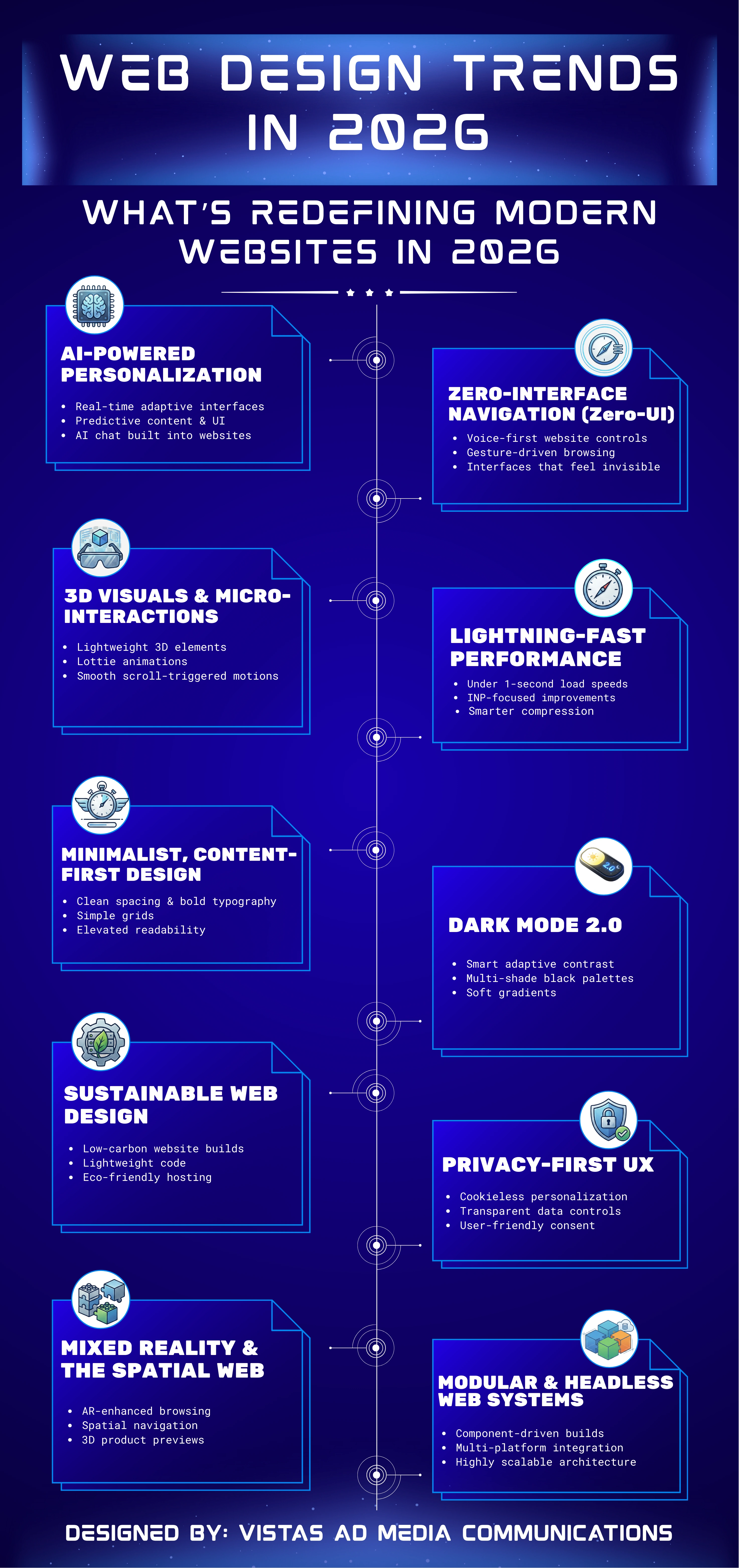
AI-driven personalisation, hyper-responsive layouts, fast UI, accessibility-first design, voice navigation, and component-driven systems dominate 2026.
No. AI speeds up production but creative strategy, UX insight, and brand storytelling still require human expertise.
Yes. Users increasingly prefer clean, distraction-free interfaces with fast load times and simple navigation.
By focusing on speed, accessibility, personalisation, responsive design across devices, and updated UI/UX.
Absolutely. Accessibility, mobile UX, speed, structured content, and user engagement have major ranking impact.
The cross-functional team of experienced professionals, combined with our customer driven approach to services, has
made Vistas a trusted marketing communications partner to scores of organizations far and wide. Explore the various
services we offer and find out more about the value we can add to you and your organization.
Contact us with details of your requirement. We will get back to you within 24 hours.
 info@vistasadindia.com
 +91 9686697971